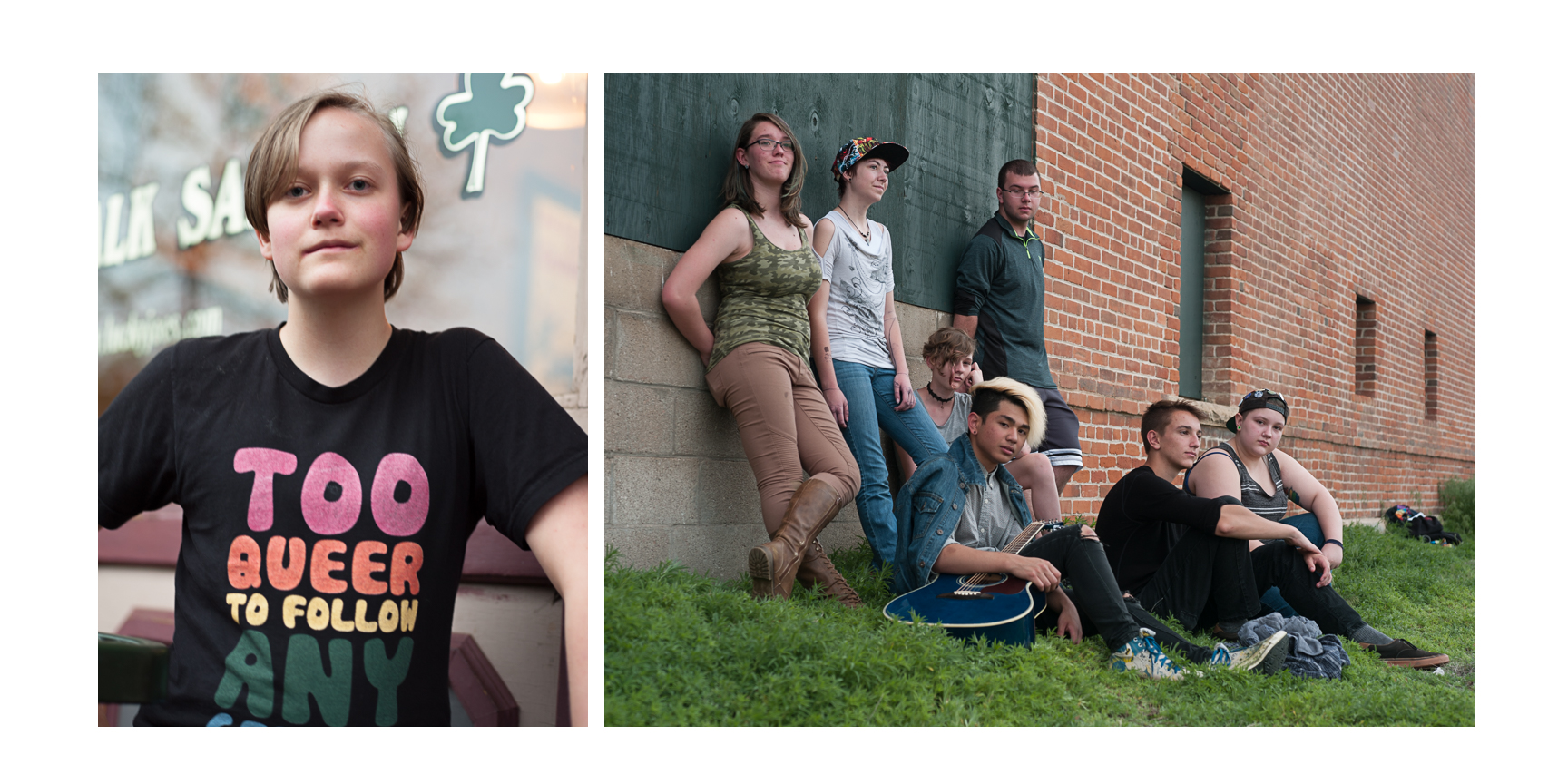
On a sunny Friday in May, students are outside teamed up and participating in an annual event of the Crew Games. The entire secondary school, grades 6–12, are rallying around their teammates — it's like something out of Harry Potter, as the students work through events that will result in one team winning the cup. These are a diverse set of youth, although they wear t-shirts that proudly identify which team they belong to, their individuality shines brightly. There are piercings and a rainbow of hair color and hair styles. This school is unique: a small K–12 school of choice, part of the district in this northern Colorado college town. The community is a tight-knit family of staff and students, some of whom have been here since kindergarten, and more recently — especially within the LGBTQ+ community — this school has become a safe place for transitioning and alternative youth of all kinds.
A 2015 study by J. Walter Thompson Intelligence found that in youth ages 13–20 only 48% identify as completely heterosexual and 6% as completely homosexual, leaving a very broad range of in-between. Gender identification is no different; the vast majority of Gen Z and millennials feel people are exploring gender more than in the past. How are educators and the adult population both supporting and understanding this shift?
Many of us are no stranger to Alfred Kinsey and his team's work on sexuality in the late '40s and '50s. Released in 1948, the Kinsey scale was developed to account for research evidence that people did not necessarily only fit in an extreme view of the heterosexual or homosexual sexuality binary. Ranging from 0–6, this same scale was the one used in the JWT study. Back when it was released in 1948, Kinsey's research had found that 46% of males had engaged in or "reacted to" a member of the same sex. When Kinsey released his report on women five years later, their numbers were far behind. What is interesting about the two studies is that now young women are either expressing more interest on the scale or feel comfortable in revealing their preferences. Through the years, Kinsey's scale has become widely questioned due to its inability to successfully address the complex issues of sexuality and gender. Even Kinsey believed in sexuality and gender fluidity, revealing that ideas and preferences changed over time. Several attempts have been made to address these shortcomings, and last year in a paper released in the Archives of Sexual Behavior, Sari van Anders, Associate Professor of Psychology and Women's Studies at the University of Michigan, released a new profile called Sexual Configurations Theory (SCT). According to van Anders, "SCT provides a testable empirically grounded framework for understanding diverse partnered sexualities in ways that are meaningfully rooted in and accountable to lived experiences and cultures." SCT works to provide a more comprehensive structure for research by including experience — in the form of partners — and a distinction between erotism and nurturing, which have most often been designated together as sexuality. Including these factors helps academics to better frame their research, but what does it do to address the confusion surrounding these labels and distinctions for the rest of us?
Opening up the discussion
In an independent coffee shop, parents sit and chat while their kids meet outside in the park. This is a group for LGBTQA+ ages 11–18, but one of their members who just transitioned a little more than a month ago is only in the fifth grade. Her parents are supportive and genuine, embracing their new peer group. Things are so fresh that pronouns haven't become second nature yet, yet they are here to support their kids as they build relationships in the LGBTQ+ community. Her parents are excited that she will be attending the K–12 school mentioned earlier — they've heard it is welcoming and open. Bullying is quickly shut down, not just by staff but students alike. But even at schools with progressive and accepting policies, we are still struggling to find a path towards educating everyone about the current research that is so distanced from sexual education programs today. We chat about schools that are more and less accepting to help kids transition. I hear stories of fabulous administrators and those put out by the extra work. Mostly they talk about how they have been really lucky. They feel welcomed and safe. I get snippets of the other side: the family members who turn away and refuse to communicate, the ones who are superficially supportive. It is groups like these that include parents where the strength in the students is coming from. As more parents have frank conversations with their children about issues once considered taboo, they share the burden that previous generations as youth had to carry. This is not the norm everywhere, but it is a growing trend.
Their comments echo work by researchers Lesley Newson and Peter Richerson on kin theory and changing family structures: the argument is that the application of kin theory to evolving views of alternative lifestyles and gender predesignation is a direct factor of rapidly changing economic development, resulting in the distancing of individuals from extended family relationships. This distancing allows for individuals to find more cultural influence from peers, media, workplace, and educators, allowing for a breakdown of traditional views that often supported and advocated for the growth of the family line. Some might see this as a breakdown of "family values" and fight to maintain historic views of traditional paths for men and primarily women — exercising beliefs about elder roles in youth decisions about everything from partners, careers, and divorce. It is safe to say that the movement away from kin influence is not always a bad thing. Access to information via media and the internet has provided youth with a growing world view that moves past "father knows best," allowing for the conversation and exploration of ideas developed outside the family unit.
Finding identity; and understanding others
There is a lot of indecision in the room as we try to order pizza for ten. Much like their opinions about gender and sex, this is a diverse group. Three present as a sex other than the one they were assigned at birth; the rest are exploring their ideas of what gender means and how they relate to the desires and emotions they are or aren't feeling at this point in their lives. They have gathered here today with me to share their thoughts and stories surrounding gender identity and sexuality. Some look a little nervous, but the pizza brings us together — there's nothing like breaking bread to get a few students chatting. We go around the table to introduce ourselves and share names and preferred pronouns. The irony that we are in a sports bar is not lost on the group, and they turn off the TV that is set to a ball game. The group is undaunted, and we jump right into the water that is gender and sexuality. Often, teens are portrayed as nervous and embarrassed when it comes to talking about these issues, but this group holds nothing back — they are open and honest and raw. Almost all cite the internet as a primary source for self-education and information, watching videos or seeking out LGBTQ+ friendly information. Several recount when they "discovered" how they didn't quite fit into the binary system.
For Tess, it was just posed in a simple question. "I figured out I was gay when a girl that I had a crush on but I didn't know was a crush asked, and she's like, 'Hey, what's your sexuality?' It's like, I didn't realize I had options. From there I did a lot of internet research to figure out what kind of other options there were and then learning more terms and then getting involved in the community to learn more about other terms, or other people." Others shared a more painful experience. Jem remembers feeling different at a fairly young age but, "I didn't really figure out what it was until I was online. I figured out that was a thing. I just thought something was wrong with me from age ten to thirteen. Then I just suffered forever." Jem reads like a movie character. He is of a slight build, initially quiet but brazenly open once the others start sharing. Jem's parents don't approve of his transition, and he spends a lot of time out of the house or at a neighbor's home. He works part-time after school to help pay for his drugs that aid in transition — drugs that he obtains outside the typical channels. Jem brings up some very critical questions that as a society we need to address. How do we help the kids who don't have support from family? The ones that make up so many of the tragic statistics we hear on the news, the high suicide rates, the violence.
The youth who are "just gay" categorize themselves as lucky, but Tess shared how most aversion comes from adults. "The only very significant homophobia I've experienced has been from adults. Other kids, they'll stop if I be like, 'You know what, that's not okay.' They'll stop. Adults will brush me off or tell me that I need to chill out." Those who present as cis-gender (presenting as the gender they were born with) find the world is a lot more open than it used to be, but even race can play into it. Tristan mentioned how, "my perspective is that when you look at the media and you see the epitome of the gay man, what you see isn't me. What you see isn't a black man or a bald man. They're not a minority. They're always white. They're always extremely attractive. It's so problematic. You'd look at magazines before and you'd see someone that is colored. You'd see someone that is a man but he's straight and he's an ally — but you don't see us. It's like we're not part of the community really. Then you look at social dating apps. Immediately you just see a bunch of descriptions that are like, 'No Asian people. No black people. Only white people please.' They are really specific. They try to defend it, like it's just a type. It's not a type — you're being racist."
Defining the labels
When it came to discussing labels, the younger students definitely had more need to define themselves. Pronouns and terminology were critically important. As they got older, these labels seemed less important, and more a choice to connect with a term they felt really described who they were — definitions that expanded the scope of classification.
Understanding how youth see themselves and each other plays an important role in mentoring adults such as teachers, counselors, and administrators. Presenting important adults in youth's lives with tools to both help students and themselves understand and be able to vocalize correctly direct terminology and pathways for descriptions about youth identification is a step some learning institutions are beginning to take, but it should become a foundational component in both educational training and professional development. This is not for just the LGBTQ+ youth — the entire community benefits when vocabulary, ideology, and possibility of expression are presented as part of a human growth and development program.
Cas recalled a story from sixth grade when they (Cas prefers they/them pronouns) and a friend were chatting about designations. Cas is tall, with closely shorn dark blond hair. They are an obvious leader, gregarious and smiling often, a little bit on the goofy side. Dressed in jeans and a baggy t-shirt, Cas presents as a typical 8th-grade male. They remembered walking down the hall with a friend and being asked, "Is there a word for when you're just sort of attracted to everyone where it's not really like gender mattering?" Cas mentioned having spent a fair amount of time on the internet discovering terms and answered, "Well, that sir would be pan." (As in pan-sexual.) Ze made a comment like, "That's bread in Spanish. I'm pan." "I was like, 'That's great. I did a good thing.' I just felt really good going into French class."
As the terminology changes, it's important to remember the core pieces that individuals are addressing when it comes to gender and sex. Often these terms are so easily interchanged without really paying attention to what the words are trying to define. T.J. Jourian, for New Directions in Student Services, recently addressed the historical and present nature of defining a new generation. More important than the host of words that individuals and cultures use to describe the wide variety of preferences and states, Jourian suggests the practice of four foundational concepts. Sex, defined as the hormonal, biological assignment at birth. Gender identity, the socio-historical and culturally constructed roles based upon an assigned sex. Gender expression, which represents the enactment of gender — not predetermined by assigned sex, but the qualities of a gender, such as feminine or masculine. Lastly, sexual orientation, which encompasses one's attractions. A bit more complicated by the previous additions proposed by Sexual Configurations Theory — when we take into account partners, erotism, and nurturing. Jourian also utilizes the ever-so-popular Kinsey scale to remind us that very few humans are on the edges of completely hetero or homosexual, not to mention asexual.
One term used to describe these fluid classifications is homo- or hetero-flexible. Tristan, a soulful high schooler of Pacific Islander ethnicity, described a story when he heard the term on a YouTube video. "I found homo-flexible. Just described the whole primarily homosexual tendencies and feelings with maybe a bit of that full heterosexual element that you want. That was just like a really great moment. It really resonated with me. I was really happy."
Acknowledging that throughout all of the terminology, it is important that both practitioners and scholars have an ethical responsibility to promote the progressive views we are finding among students today, and cultivate an openness to adopt practices that embrace the shifting terminology and promote both individual and community understanding.
Integrating the conversation into instruction
Teachers are familiar with cultural inclusion in curriculum. Part of student learning needs to reflect the expansive range of diversity we find in the human race. Gender and sexuality should be no different — yet a 2015 study found that in schools with youth ages 12–18, only 12 percent said that their sex education classes covered same-sex relationships, and less than five percent reported LGBT-related topics in their health classes. The statistics also widely vary when it comes to school support as well. The CDC identified five factors for LGBTQ+ objectives regarding safety: education, harassment, professional development, outside health access, and outside social and psychological services — yet only 2.1% to 27.2% of schools across states engaged in all five practices. The kicker here is that even if a school doesn't have an LGBTQ+ identified student, chances are one is there, and chances are youth within those schools have or will have interactions with the LGBTQ+ population at some point in their lives. Why aren't schools including this information? Current biological research is supporting what sexuality and psychological research has been saying for half a century: humans are individuals, and utilizing a binary classification system — even for biological systems — is problematic. Given all this research and evidence, schools should be making decisions to provide students with information that is relevant, informative, and inclusive.
Resources for educators and schools
Sexuality and gender can be extremely touchy subjects, especially among administration and even teachers. Many of those who hold roles of administration grew up in a time when sexual education stuck to the biological facts. Homosexuality was not discussed, and it's still a battle in many places to even discuss birth control. Yet as educators, we know knowledge is power. Better access to information and education has teen birthrates at record lows. As we work to include women and people of all nations and colors in our curriculum, it is important to consider and elevate the level to which we discuss not just terminology that reflects the LGBTQ+ members of our classrooms, but also the research that reflects that sexual and gender fluidity is the norm and not the exception. The students are rapidly outpacing educators in this arena, and we must work to convince parents, administrators, and school boards that this is bigger than a youth picking what bathroom to use. This is about providing acceptance and vocabulary to help everyone find their place.
A few resources of curricula that are inclusive and based in academic research:
Best Practices: Creating an LGBT-Inclusive School Climate — A Teaching Tolerance Guide for School Leaders. Document produced by tolerance.org.
Our Whole Lives: Lifespan Sexuality Education — uua.org/re/owl